Tamizaje clínico de la presión arterial y el pulso durante el primer tiempo de acostado, de pie (ortostatismo) prolongado, segundo tiempo de acostado y finalmente sentado.
La evaluación de la presión arterial y del pulso nos ayuda a comprender cómo funcionan los nervios especializados en controlar las fluctuaciones de la presión arterial y del pulso en diferentes posiciones del cuerpo. La disfunción de estos nervios (llamada disfunción del barorreflejo) puede manifestarse por dos vías distintas de anormalidad: falla aferente o falla eferente. Una vez clasificado el tipo de falla, esto nos ayuda a establecer el diagnóstico de disautonomía de manera más eficiente y precisa.
Cómo hacer el registro
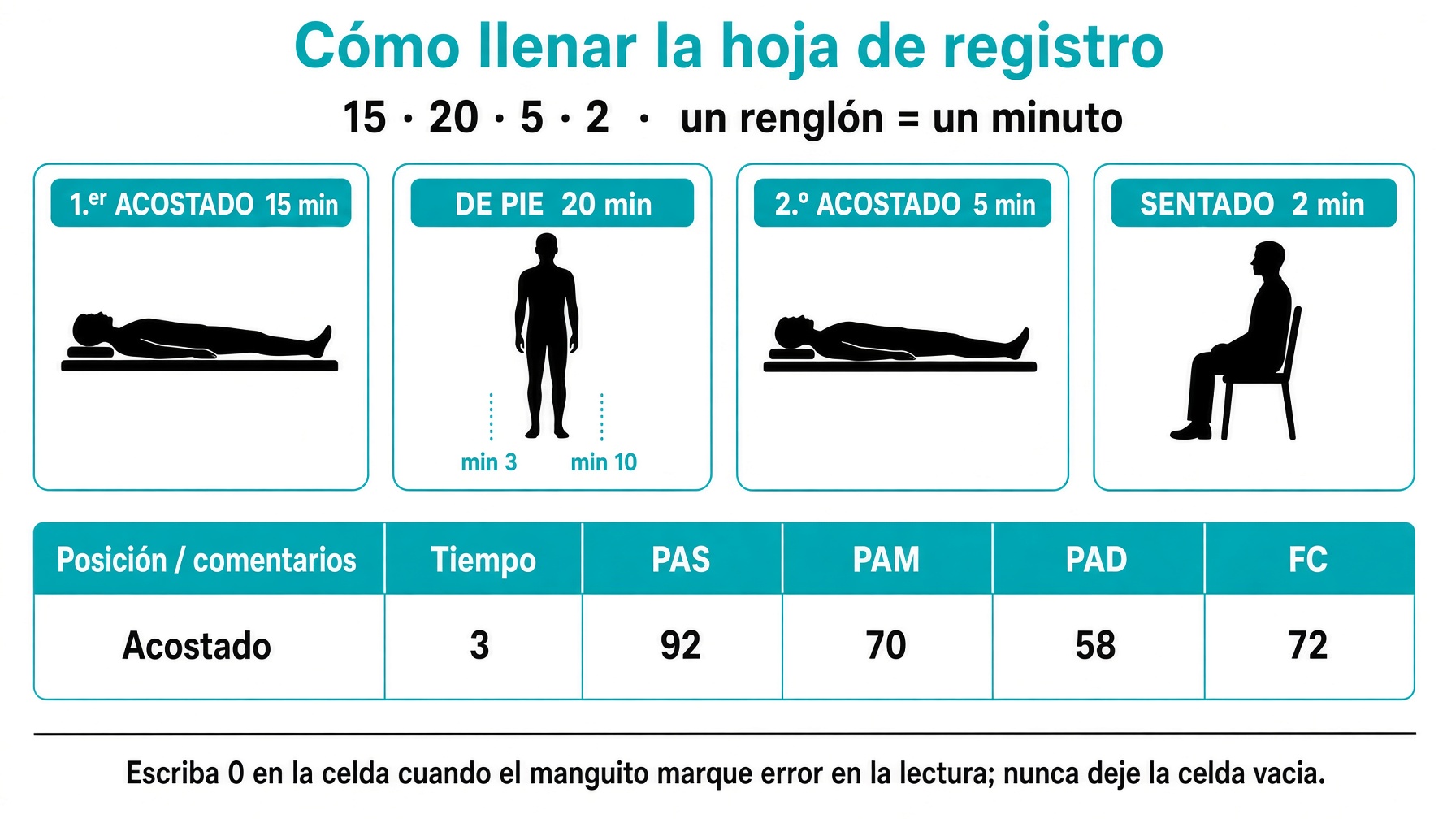
Protocolo Santa Fe (15–20–5–2)
42 tomas en cuatro posiciones, en este orden. La gráfica solo muestra los minutos que usted escribió. Si se salta de pie o sentado, la lectura queda incompleta.
15 · 20 · 5 · 2 · un renglón = un minuto
15
1.er acostado
20
De pie
05
2.º acostado
02
Sentado
Marcas en los minutos 3 y 10 de pie (hipotensión ortostática neurógena).
Renglón de ejemplo — minuto 3 de pie
Posición corporal/comentarios
De pie
Tiempo
3
PAS
92
PAM
70
PAD
58
FC
72
Posición corporal/comentarios
Escriba un evento si ocurrió algo (el paciente se encontraba hablando / dolor en el brazo por tomas continuas / cansancio por estar de pie de forma prolongada, etc.). No se detenga y continúe con el registro de presión arterial y pulso.
Tiempo
Minuto de esa posición (0, 1, 2…). De pie, no brinque los minutos 3 y 10.
PAS · PAD · FC
Sistólica, diastólica (mmHg) y pulso (latidos por minuto). Escriba 0 cuando el manguito marque error; nunca deje la celda vacía.
PAM
Presión arterial media. Opcional en el teléfono; el lector puede calcularla.
01
Acuéstese. Quédese quieto. Anote presión y pulso cada minuto durante 15 minutos (15 renglones). No se levante.
02
Póngase de pie y quédese de pie. Un renglón nuevo cada minuto durante 20 minutos (minutos 0 a 20). No brinque los minutos 3 y 10. No apague el manguito.
03
Acuéstese otra vez. 5 minutos, un renglón por minuto.
04
Siéntese. 2 minutos, un renglón por minuto.
05
Si habla, tiene dolor, toma la mano libre, mastica, aprieta o hace un esfuerzo, siga registrando. Anote en comentarios lo que hacía. No deje un hueco: la gráfica no inventa ese minuto.
06
Llene la hoja Encuesta: elija No, Previo o Actual en cada condición. Va en el mismo archivo que las presiones, para que historia y trazo sean un solo expediente.
Un renglón = un minuto real. Si el manguito marca error, escriba 0 — nunca deje la celda vacía y nunca invente un número. La figura solo dibuja los renglones que llenó.
Encuesta — condiciones que tuvieron o tienen ahora
Elija No / Previo / Actual. Se guarda con esta visita. Descargar escribe esas marcas al Excel (también es la pestaña Encuesta). El registro se lee primero; la historia orienta, no recodifica el estante.
Endarterectomía carotídea / cirugía vascular de cuello
Cáncer o radiación de cuello
Fármaco presor
Quiénes pueden hacerse este registro
Niños, adolescentes y adultos — cuando se sospecha disautonomía.
Use la bipedestación pasiva prolongada cuando la visita plantea una sospecha concreta, no como chequeo general. Diagnostica la disfunción del barorreflejo como nOH, OH no neurógena, POTS, vasovagal o HTA lábil. No indica tratamiento.
Quiénes
Niños
Adolescentes
Adultos
Posterior a infección por COVID-19
Sinucleinopatías
Autoinmunidad
Sin causa aún clara
Neurodegenerativo / sinucleinopatía
Enfermedad de Parkinson
Otros parkinsonismos degenerativos
Atrofia multisistémica
Demencia con cuerpos de Lewy
Falla autonómica pura
Enfermedad de Huntington
Hidrocefalia normotensa
Ataxias
Leucodistrofias del adulto
Síndromes autonómicos
Hipotensión ortostática neurógena
POTS
Síncope vasovagal mediado neuralmente
Hipertensión neurogénica
Hipertensión episódica lábil
Causas secundarias de hipertensión neurogénica paroxística
Ganglionopatía autonómica autoinmune
Condiciones y síntomas asociados
Espectro hipermóvil
Neuropatía de fibra pequeña
Fibromialgia
Migraña de difícil control
Trastornos neurológicos funcionales
Adenomiosis
Mareo al ponerse de pie
Fatiga, palpitaciones, intolerancia al esfuerzo, niebla mental
La vía de salida. Los vasos no defienden la PA. Típico: nOH, poco aumento de FC, HTA supina, rebote al horizontal. Kaufmann 2018: ΔFC/|ΔPAS| < 0.5 durante la hipotensión diagnostica nOH. La AMS puede subir más el pulso que la nOH por cuerpos de Lewy — eso no recodifica el estante. La caída de flujo cerebral con síntomas antes de la nOH (glucosa, comida) es denervación inicial, no un trazo sano.
Vía de detección
Aferente · espectro de barorreflejo
La vía de detección / amortiguamiento. La FC aún puede disparar. Incluye POTS (FC sostenida +≥30), hipertensión episódica lábil, síncope vasovagal. El Parkinson no recodifica un trazo aferente: un pulso rígido sin colapso vasovagal puede ser denervación parasimpática inicial. No llame a esto falla autonómica.
Control
Íntegro
De pie, fluctuación de presión y pulso equilibrada, sin extremos, con retorno a basal de reposo sin disminución o incrementos extremos. Clínicamente asintomático.
Definiciones de consenso
Etiquetas de la literatura para diagnosticar disfunción del barorreflejo aferente vs eferente.
Hipotensión ortostática neurógena (nOH)
No se cumple en este trazo
Consenso (Freeman 2011): caída sostenida de PAS ≥20 mmHg o PAD ≥10 mmHg en los 3 primeros minutos de bipedestación, con aumento inadecuado de FC <15 lpm. Kaufmann 2018: durante la hipotensión un ΔFC/|ΔPAS| < 0.5 lpm/mmHg diagnostica nOH (aumento medio de FC ~8 lpm vs ~25 en la no neurógena). La AMS puede aumentar más la FC que las enfermedades por cuerpos de Lewy, con solapamiento.
OH no neurógena
No se cumple en este trazo
Los mismos criterios de PA en los 3 primeros minutos de bipedestación, con aumento apropiado de FC ≥15 lpm.
OH tardía
No se cumple en este trazo
Los mismos criterios de PA (caída de PAS ≥20 o PAD ≥10) que aparecen por primera vez después de los 3 minutos de bipedestación.
Disfunción del barorreflejo aferente
Esta visita cumple
Falla de detección / amortiguamiento, no de la vía de salida. Incluye síncope vasovagal (neuromediado) — PA y FC que caen juntas — e hipertensión episódica lábil con brotes presores al hablar, al dolor o al apretar la mano. Cirugía de cuello, endarterectomía carotídea o cáncer/radiación de cuello apuntan a falla adquirida del barorreflejo aferente; sin ese antecedente, los mismos patrones son el polo funcional del espectro (POTS, vasovagal, HTA lábil). No son falla autonómica.
Hipertensión supina neurógena
No se cumple en este trazo
PAS supina ≥140 mmHg y/o PAD ≥90 mmHg en presencia de falla autonómica.
Hipoperfusión cerebral ortostática (OCHOs)
La velocidad de flujo cerebral de pie cae (o se vuelve irregular) mientras la presión arterial sistémica y el pulso permanecen en un rango ortostático normal: no hay hipotensión ortostática ni taquicardia postural. OCHOs solo si la intolerancia ortostática es inexplicada y no hay sinucleinopatía ni falla autonómica. En AMS/EP la misma caída de flujo es denervación eferente inicial de la autorregulación cerebral, a menudo desenmascarada por glucosa; no es un trazo sano. Novak, Front Aging Neurosci. 2016.
Referencias
Freeman R, Wieling W, Axelrod FB, et al. Consensus statement on the definition of orthostatic hypotension, neurally mediated syncope, and postural tachycardia syndrome. Clin Auton Res. 2011;21(2):69-72.
Idiaquez JF, Idiaquez J, Casar JC, Biaggioni I. Neurogenic orthostatic hypotension. Lessons from synucleinopathies. Am J Hypertens. 2021;34(2):125-133.
Gibbons CH, Schmidt P, Biaggioni I, et al. The recommendations of a consensus panel for the screening, diagnosis, and treatment of neurogenic orthostatic hypotension and associated supine hypertension. J Neurol. 2017;264(8):1567-1582.
Farella M, Bakke M, Michelotti A, Marotta G, Martina R. Cardiovascular responses in humans to experimental chewing of gums of different consistencies. Arch Oral Biol. 1999;44(10):835-842. doi:10.1016/s0003-9969(99)00074-6.
Khurana RK, Setty A. The value of the isometric hand-grip test—studies in various autonomic disorders. Clin Auton Res. 1996;6(4):211-218. doi:10.1007/BF02291136.
Flaa A, Ekeberg Ø, Kjeldsen SE, Rostrup M. Personality may influence reactivity to stress. Biopsychosoc Med. 2007;1:5. doi:10.1186/1751-0759-1-5.
Fagius J, Karhuvaara S, Sundlöf G. The cold pressor test: effects on sympathetic nerve activity in human muscle and skin nerve fascicles. Acta Physiol Scand. 1989;137(3):325-334. doi:10.1111/j.1748-1716.1989.tb08760.x.
Peterson RR, Sandeep G. Cold pressor test as a predictor of hypertension in normotensive medical students. Int J Pharm Clin Res. 2023;15(7):787-789.
Jansen RW, Penterman BJ, van Lier HJ, Hoefnagels WH. Blood pressure reduction after oral glucose loading and its relation to age, blood pressure and insulin. Am J Cardiol. 1987;60(13):1087-1091. doi:10.1016/0002-9149(87)90358-4.
Zhou X, Wu T, Sang M, et al. Variations in blood pressure after a 75 g oral glucose load and their implications for detecting hypertension and postprandial hypotension in Chinese adults: a cross-sectional study. Eur J Prev Cardiol. 2025;32(14):1382-1391. doi:10.1093/eurjpc/zwaf217.
Norcliffe-Kaufmann L, Kaufmann H, Palma JA, et al. Orthostatic heart rate changes in patients with autonomic failure caused by neurodegenerative synucleinopathies. Ann Neurol. 2018;83(3):522-531. doi:10.1002/ana.25170.
Thijs RD, Wieling W, Kaufmann H, et al. Recommendations for tilt table testing and other provocative cardiovascular autonomic tests in conditions that may cause transient loss of consciousness. Clin Auton Res. 2021;31(3):369-384.
Palma JA, Kaufmann H. Epidemiology, diagnosis, and management of neurogenic orthostatic hypotension. Mov Disord Clin Pract. 2017;4(4):298-308.
Wieling W, Kaufmann H, Claydon VE, et al. Diagnosis and treatment of orthostatic hypotension. Lancet Neurol. 2022;21(8):735-746.
Mehr PE, Ortiz PJ, O'Rourke KR, et al. Peripheral autonomic failure is associated with more severe postprandial hypotension compared to central autonomic failure. Clin Auton Res. 2025;35(4):607-616.
Cani I, Guaraldi P, Giannini G, et al. Levodopa-induced orthostatic hypotension in parkinsonism: a red flag of autonomic failure. Eur J Neurol. 2024;31(1):e16061.
Novak V, Novak P, Spies JM, Low PA. Autoregulation of cerebral blood flow in orthostatic hypotension. Stroke. 1998;29(1):104-111.
Novak P. Orthostatic Cerebral Hypoperfusion Syndrome. Front Aging Neurosci. 2016;8:22. doi:10.3389/fnagi.2016.00022.
Horowitz DR, Kaufmann H. Autoregulatory cerebral vasodilation occurs during orthostatic hypotension in patients with primary autonomic failure. Clin Auton Res. 1995;5(5):233-236.
Respuestas esperadas en pruebas activas durante el ortostatismo
Maniobras opcionales en el registro de pie. Se comparan con el reposo de pie de la misma visita. No recodifican el estante (aferente / eferente / sano).
Prueba de masticación (chicle)
Exagerada
Esperado: incremento de PAS 10–15 mmHg, PAD 8–10 mmHg y FC >11 lpm.
Esta visita: ΔPAS 23 · ΔPAD 5 · ΔFC 0
Prensión manual sostenida
Embotada
Esperado: incremento sostenido de PAD de 15–25 mmHg.
Esta visita: ΔPAS 24 · ΔPAD 3 · ΔFC -1
Estrés cognitivo
No se hizo
Esperado: incremento de PAS 15–25 mmHg y PAD 8–12 mmHg durante la actividad, con retorno al reposo al suspender la maniobra.
Estímulo frío (cold pressor)
No se hizo
Esperado: incremento transitorio de PAS hasta 20 mmHg, PAD hasta 10 mmHg y FC 10–20 lpm en los primeros 30 segundos, no sostenido.
Barorreflejo íntegro. La presión se defiende; el pulso sube poco.
Sano
Números del protocolo
Protocolo Santa Fe (15–20–5–2) · 36 min
Protocolo Santa Fe: 15 minutos recostado → 20 minutos de pie quieto → 5 minutos recostado otra vez → 2 minutos sentado. Una toma cada minuto. No se salte ninguna posición. Si habla, tiene dolor, toma la mano, mastica, aprieta o se mueve: siga con el manguito y anote en comentarios lo que hacía.
PAS 1.er acostado
118
PAS de pie
126
Δ de pie − acostado PAS
+8
Δ de pie − acostado FC
+1
Nadir ΔPAS
-3
Pico ΔFC
+5
ΔFC / |ΔPAS|
—
Retorno − acostado
+1
3 min de pie
ΔPAS
+3
ΔFC
+3
ΔFC/|ΔPAS|
—
Neurógena
—
10 min de pie
ΔPAS
-1
ΔFC
+1
ΔFC/|ΔPAS|
0.50
Neurógena
—
Tres trazos — sin superponer
Las mismas escalas de PA y FC en los tres. Lea cada trazo por separado.
PAS
PAD
Pulso
1 · Sano
Referencia sana
ΔPAS +7.5 · ΔFC +1.1
1.º recostado
de pie
2.º recostado
sentado
Cada minuto de esa posición. El espacio en blanco separa el acostado inicial, de pie, el segundo acostado y sentado. PAS y PAD negras, pulso rojo. Un hueco largo no se une.
2 · Ejemplo del atlas
Caso 3
ΔPAS -68.0 · ΔFC +7.3
1.º recostado
de pie
2.º recostado
sentado
Cada minuto de esa posición. El espacio en blanco separa el acostado inicial, de pie, el segundo acostado y sentado. PAS y PAD negras, pulso rojo. Un hueco largo no se une.
3 · Este caso
Referencia sana
ΔPAS +7.5 · ΔFC +1.1
1.º recostado
de pie
2.º recostado
sentado
Cada minuto de esa posición. El espacio en blanco separa el acostado inicial, de pie, el segundo acostado y sentado. PAS y PAD negras, pulso rojo. Un hueco largo no se une.
Registro minuto a minuto
Cada toma del manguito, como en el BaroSheet. Las cuatro posiciones van separadas: acostado inicial, de pie, segundo acostado y sentado. PP es la sistólica menos la diastólica.
1.er acostado
PP media 61 mmHg
Min
PAS
PAD
PP
PAM
FC
-17
118
54
64
75.3
61
-16
119
51
68
73.7
60
-15
116
54
62
74.7
64
-14
125
56
69
79
61
-13
120
55
65
76.7
62
-12
118
58
60
78
66
-11Respiración
116
59
57
78
69
-10Respiración
115
61
54
79
67
-9Respiración
114
62
52
79.3
71
-8Respiración
117
63
54
81
66
-7
120
59
61
79.3
61
-6
118
58
60
78
62
-5
119
59
60
79
64
-4
118
60
58
79.3
68
-3
121
58
63
79
66
-2
119
59
60
79
64
-1
120
56
64
77.3
61
De pie
PP media 64 mmHg
Min
PAS
PAD
PP
PAM
FC
1
117
57
60
77
63
2
115
57
58
76.3
68
3
121
58
63
79
67
4
118
57
61
77.3
69
5
117
57
60
77
68
6
119
60
59
79.7
66
7
122
60
62
80.7
69
8
118
57
61
77.3
67
9
120
59
61
79.3
68
10
117
58
59
77.7
65
11
123
60
63
81
62
12
123
60
63
81
62
13Masticar
145
64
81
91
61
14Masticar
142
66
76
91.3
66
15Masticar
144
65
79
91.3
64
16Masticar
135
66
69
89
63
17
124
61
63
82
69
18
121
63
58
82.3
68
19
126
67
59
86.7
66
20
124
64
60
84
69
21
123
67
56
85.7
67
22
121
64
57
83
68
23Agarre
146
63
83
90.7
65
24Agarre
142
65
77
90.7
62
25Agarre
144
64
80
90.7
63
26
133
61
72
85
68
27
121
62
59
81.7
66
28
126
63
63
84
63
29
122
64
58
83.3
62
30
125
67
58
86.3
65
31
124
65
59
84.7
64
32
125
66
59
85.7
63
33
124
61
63
82
68
34
121
58
63
79
66
35
123
66
57
85
63
36
122
62
60
82
60
2.º acostado
PP media 61 mmHg
Min
PAS
PAD
PP
PAM
FC
1
118
57
61
77.3
59
2
122
56
66
78
60
3
118
60
58
79.3
64
4
119
58
61
78.3
61
5
120
61
59
80.7
63
Sentado
PP media 50 mmHg
Min
PAS
PAD
PP
PAM
FC
1
100
55
45
70
62
2
110
56
54
74
68
Estantes docentes
78 casos docentes. Envíe el siguiente libro con el estante (eferente · aferente · taquicardia postural · vasovagal · sano). Entra como Caso N — sin nombres.